AssetEmbeddingsInChina
Learning asset embeddings from partial institutional holdings in China's A-share market. Companion training code for the working paper "Do Asset Embeddings Need Complete Holdings? Lessons from China" (2026).
Following Gabaix et al. (2025), we treat each investor's portfolio as a sentence and each stock as a token: rank order carries economic meaning (the largest position is the primary exposure), just as word order carries meaning in language. This lets us learn asset representations with NLP techniques for asset pricing and investor modeling.
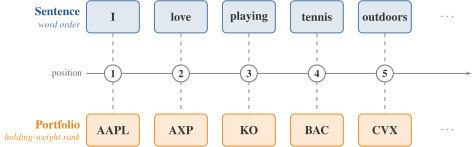
What the paper does differently
The estimation departs from Gabaix et al. in two respects, and both answer one question: how can latent demand factors be estimated when holdings are only partially observed? China's hybrid disclosure rules act as a censoring filter on the true holdings.
First, pretrain–finetune instead of independent quarterly fits: embeddings fitted quarter by quarter are identified only up to a rotation and are therefore not directly comparable over time. Pretraining once on the first 80% of holding observations (chronological split, cutoff 2023Q1: 73 quarters for pretraining, 6 for quarterly fine-tuning) and initializing every quarterly fine-tune from that base makes the rotations more likely to agree — pretraining learns the common, stable holding structure, finetuning captures the quarter-specific variations. Second, warm-starting BERT's embedding layer from the trained Word2Vec embeddings rather than random vectors, which gives the assets that censored disclosure leaves thinly observed a sensible prior. See Method: paper ↔ code.
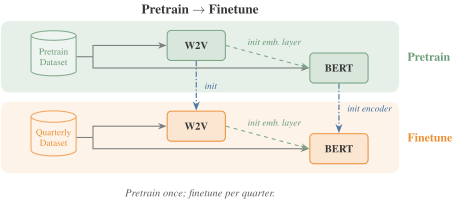
What the repo delivers
A training framework for the full embedding pipeline: three models (recommender system, Word2Vec, BERT), the pretrain–finetune estimation, and the supporting data tooling. The output is a quarterly sequence of embedding CSVs — one vector per stock per quarter, comparable over time. The companion paper studies how well these embeddings explain firm valuations and return correlations.
Quickstart
git clone https://github.com/Initial-Singularity/AssetEmbeddingsInChina
cd AssetEmbeddingsInChina
uv sync --extra notebook                      # notebook + ipykernel are demo-only extras
uv run jupyter lab examples/quickstart.ipynb  # or: uv run python examples/quickstart.py
The notebook runs the full W2V-PT → W2V-FT → BERT-PT → BERT-FT chain on a synthetic dataset shipped in examples/data/ (CPU, ~1 minute), ending with four embedding CSVs. Real production runs require CSMAR data — see Prepare data. Full walkthrough: Quickstart.
Where to go
- New here? Quickstart
- A recipe? Install · Prepare data · Train
- The "why"? Method & experiments
- Just the embeddings? Download them from Zenodo: 10.5281/zenodo.20640781 (CC-BY-4.0)
- Looking something up? CLI reference · API reference
Citation
@unpublished{cheng2026asset,
  title  = {Do Asset Embeddings Need Complete Holdings? Lessons from China},
  author = {Cheng, Zitong and Huang, Dashan and Liu, Xiaobin and Zeng, Tao},
  year   = {2026},
  note   = {Working paper},
}
The trained embeddings are archived on Zenodo (CC-BY-4.0): 10.5281/zenodo.20640781.